
Click on Picture
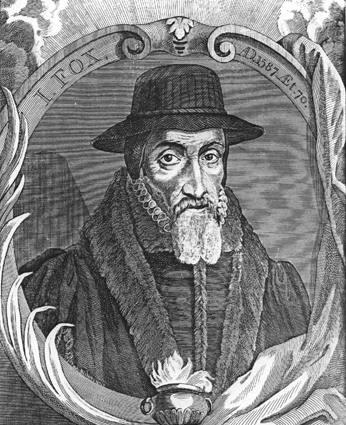
This is a book that will never die. One of the great English classics. Interesting as fiction, because it is written with both passion and tenderness, it tells the dramatic story of some of the most thrilling periods in Christian history.
Reprinted here in its most complete form, it brings to life the days when "a noble army, men and boys, the matron and the maid," "climbed the steep ascent of heaven, 'mid peril, toil, and pain."
"After the Bible itself, no book so profoundly influenced early Protestant sentiment as the Book of Martyrs. Even in our time it is still a living force. It is more than a record of persecution. It is an arsenal of controversy, a storehouse of romance, as well as a source of edification."
A HISTORY OF THE LIVES, SUFFERINGS AND TRIUMPHANT DEATHS OF THE EARLY CHRISTIAN AND THE PROTESTANT MARTYRS
"When one recollects that until the appearance of the Pilgrim's Progress the common people had almost no other reading matter except the Bible and Fox's Book of Martyrs, we can understand the deep impression that this book produced; and how it served to mold the national character. Those who could read for themselves learned the full details of all the atrocities performed on the Protestant reformers; the illiterate could see the rude illustrations of the various instruments of torture, the rack, the gridiron, the boiling oil, and then the holy ones breathing out their souls amid the flames. Take a people just awakening to a new intellectual and religious life; let several generations of them, from childhood to old age, pore over such a book, and its stories become traditions as individual and almost as potent as songs and customs on a nation's life."
"If we divest the book of its accidental character of feud between churches, it yet stands, in the first years of Elizabeth's reign, a monument that marks the growing strength of a desire for spiritual freedom, defiance of those forms that seek to stifle conscience and fetter thought."
"After the Bible itself, no book so profoundly inflienced early Protestant sentiment as the Book of Martyrs. Even in our own time it is still a living force. It is more than a record of persecution. It is an arsenal of controversy, a storehouse of romance, as well as a source of edification."
John Fox (or Foxe) was born at Boston, in Lincolnshire, in 1517, where his parents are stated to have lived in respectable circumstances. He was deprived of his father at an early age; and notwithstanding his mother soon married again, he still remained under the parental roof. From an early display of talents and inclination to learning, his friends were induced to send him to Oxford, in order to cultivate and bring them to maturity.
During his residence at this place, he was distinguished for the excellence and acuteness of his intellect, which was improved by the emulation of his fellow collegians, united to an indefatigable zeal and industry on his part. These qualities soon gained him the admiration of all; and as a reward for his exertions and amiable conduct, he was chosen fellow of Magdalen College; which was accounted a great honor in the university, and seldom bestowed unless in cases of great distinction. It appears that the first display of his genius was in poetry; and that he composed some Latin comedies, which are still extant. But he soon directed his thoughts to a more serious subject, the study of the sacred Scriptures: to divinity, indeed, he applied himself with more fervency than circumspection, and discovered his partiality to the Reformation, which had then commenced, before he was known to its supporters, or to those who protected them; a circumstance which proved to him the source of his first troubles.
He is said to have often affirmed that the first matter which occasioned his search into the popish doctrine was that he saw divers things, most repugnant in their nature to one another, forced upon men at the same time; upon this foundation his resolution and intended obedience to that Church were somewhat shaken, and by degrees a dislike to the rest took place.
His first care was to look into both the ancient and modern history of the Church; to ascertain its beginning and progress; to consider the causes of all those controversies which in the meantime had sprung up, and diligently to weigh their effects, solidity, infirmities, etc.
Before he had attained his thirtieth year, he had studied the Greek and Latin fathers, and other learned authors, the transactions of the Councils, and decrees of the consistories, and had acquired a very competent skill in the Hebrew language. In these occupations he frequently spent a considerable part, or even the whole of the night; and in order to unbend his mind after such incessant study, he would resort to a grove near the college, a place much frequented by the students in the evening, on account of its sequestered gloominess. In these solitary walks he was often heard to ejaculate heavy sobs and sighs, and with tears to pour forth his prayers to God. These nightly retirements, in the sequel, gave rise to the first suspicion of his alienation from the Church of Rome. Being pressed for an explanation of this alteration in his conduct, he scorned to call in fiction to his excuse; he stated his opinions; and was, by the sentence of the college convicted, condemned as a heretic, and expelled.
His friends, upon the report of this circumstance, were highly offended, when he was thus forsaken by his own friends, a refuge offered itself in the house of Sir Thomas Lucy, of Warwickshire, by whom he was sent for to instruct his children. The house is within easy walk of Stratford-on-Avon, and it was this estate which, a few years later, was the scene of Shakespeare's traditional boyish poaching expedition. Fox died when Shakespeare was three years old.
In the Lucy house Fox afterward married. But the fear of the popish inquisitors hastened his departure thence; as they were not contented to pursue public offences, but began also to dive into the secrets of private families. He now began to consider what was best to be done to free himself from further inconvenience, and resolved either to go to his wife's father or to his father-in-law.
His wife's father was a citizen of Coventry, whose heart was not alienated from him, and he was more likely to be well entreated, for his daughter's sake. He resolved first to go to him; and, in the meanwhile, by letters, to try whether his father-in-law would receive him or not. This he accordingly did, and he received for answer, "that it seemed to him a hard condition to take one into his house whom he knew to be guilty and condemned for a capital offence; neither was he ignorant what hazard he should undergo in so doing; he would, however, show himself a kinsman, and neglect his own danger. If he would alter his mind, he might come, on condition to stay as long as he himself desired; but if he could not be persuaded to that, he must content himself with a shorter stay, and not bring him and his mother into danger."
No condition was to be refused; besides, he was secretly advised by his mother to come, and not to fear his father-in-law's severity; "for that, perchance, it was needful to write as he did, but when occasion should be offered, he would make recompense for his words with his actions." In fact he was better received by both of them than he had hoped for.
By these means he kept himself concealed for some time, and afterwards made a journey to London, in the latter part of the reign of Henry VIII. Here, being unknown, he was in much distress, and was even reduced to the danger of being starved to death, had not Providence interfered in his favor in the following manner:
One day as Mr. Fox was sitting in St. Paul's Church, exhausted with long fasting, a stranger took a seat by his side, and courteously saluted him, thrust a sum of money into his hand, and bade him cheer up his spirits; at the same time informing him, that in a few days new prospects would present themselves for his future subsistence. Who this stranger was, he could never learn; but at the end of three days he received an invitation from the Duchess of Richmond to undertake the tuition of the children of the Earl of Surry who, together with his father, the Duke of Norfolk, was imprisoned in the Tower, by the jealousy and ingratitude of the king. The children thus confided to his care were, Thomas, who succeeded to the dukedom; Henry, afterwards Earl of Northampton; and Jane who became Countess of Westmoreland. In the performance of his duties, he fully satisfied the expectations of the duchess, their aunt.
These halcyon days continued during the latter part of the reign of Henry VIII and the five years of the reign of Edward VI until Mary came to the crown, who, soon after her accession, gave all power into the hands of the papists.
At this time Mr. Fox, who was still under the protection of his noble pupil, the duke, began to excite the envy and hatred of many, particularly Dr. Gardiner, then Bishop of Winchester, who in the sequel became his most violent enemy.
Mr. Fox, aware of this, and seeing the dreadful persecutions then commencing, began to think of quitting the kingdom. As soon as the duke knew his intention, he endeavored to persuade him to remain; and his arguments were so powerful, and given with so much sincerity, that he gave up the thought of abandoning his asylum for the present.
At that time the Bishop of Winchester was very intimate with the duke (by the patronage of whose family he had risen to the dignity he then enjoyed,) and frequently waited on him to present his service when he several times requested that he might see his old tutor. At first the duke denied his request, at one time alleging his absence, at another, indisposition. At length it happened that Mr. Fox, not knowing the bishop was in the house, entered the room where the duke and he were in discourse; and seeing the bishop, withdrew. Gardiner asked who that was; the duke answered that he was "his physician, who was somewhat uncourtly, as being new come from the university." "I like his countenance and aspect very well," replied the bishop, "and when occasion offers, I will send for him." The duke understood that speech as the messenger of some approaching danger; and now himself thought it high time for Mr. Fox to quit the city, and even the country. He accordingly caused everything necessary for his flight to be provided in silence, by sending one of his servants to Ipswich to hire a bark, and prepare all the requisites for his departure. He also fixed on the house of one of his servants, who was a farmer, where he might lodge until the wind became favorable; and everything being in readiness, Mr. Fox took leave of his noble patron, and with his wife, who was pregnant at the time, secretly departed for the ship.
The vessel was scarcely under sail, when a most violent storm came on, which lasted all day and night, and the next day drove them back to the port from which they had departed. During the time that the vessel had been at sea, an officer, despatched by the bishop of Winchester, had broken open the house of the farmer with a warrant to apprehend Mr. Fox wherever he might be found, and bring him back to the city. On hearing this news he hired a horse, under the pretence of leaving the town immediately; but secretly returned the same night, and agreed with the captain of the vessel to sail for any place as soon as the wind should shift, only desired him to proceed, and not to doubt that God would prosper his undertaking. The mariner suffered himself to be persuaded, and within two days landed his passengers in safety at Nieuport.
After spending a few days in that place, Mr. Fox set out for Basle, where he found a number of English refugees, who had quitted their country to avoid the cruelty of the persecutors, with these he associated, and began to write his "History of the Acts and Monuments of the Church," which was first published in Latin at Basle in 1554, and in English in 1563.
In the meantime the reformed religion began again to flourish in England, and the popish faction much to decline, by the death of Queen Mary; which induced the greater number of the Protestant exiles to return to their native country.
Among others, on the accession of Elizabeth to the throne, Mr. Fox returned to England; where, on his arrival, he found a faithful and active friend in his late pupil, the Duke of Norfolk, until death deprived him of his benefactor: after which event, Mr. Fox inherited a pension bequeathed to him by the duke, and ratified by his son, the Earl of Suffolk.
Nor did the good man's successes stop here. On being recommended to the queen by her secretary of state, the great Cecil, her majesty granted him the prebendary of Shipton, in the cathedral of Salisbury, which was in a manner forced upon him; for it was with difficulty that he could be persuaded to accept it.
On his resettlement in England, he employed himself in revising and enlarging his admirable Martyrology. With prodigious pains and constant study he completed that celebrated work in eleven years. For the sake of greater correctness, he wrote every line of this vast book with his own hand, and transcribed all the records and papers himself. But, in consequence of such excessive toil, leaving no part of his time free from study, nor affording himself either the repose or recreation which nature required, his health was so reduced, and his person became so emaciated and altered, that such of his friends and relations as only conversed with him occasionally, could scarcely recognize his person. Yet, though he grew daily more exhausted, he proceeded in his studies as briskly as ever, nor would he be persuaded to diminish his accustomed labors. The papists, forseeing how detrimental his history of their errors and cruelties would prove to their cause, had recourse to every artifice to lessen the reputation of his work; but their malice was of signal service, both to Mr. Fox himself, and to the Church of God at large, as it eventually made his book more intrinsically valuable, by inducing him to weigh, with the most scrupulous attention, the certainty of the facts which he recorded, and the validity of the authorities from which he drew his information.
But while he was thus indefatigably employed in promoting the cause of truth, he did not neglect the other duties of his station; he was charitable, humane, and attentive to the wants, both spiritual and temporal, of his neighbors. With the view of being more extensively useful, although he had no desire to cultivate the acquaintance of the rich and great on his own account, he did not decline the friendship of those in a higher rank who proffered it, and never failed to employ his influence with them in behalf of the poor and needy. In consequence of his well-known probity and charity, he was frequently presented with sums of money by persons possessed of wealth, which he accepted and distributed among those who were distressed. He would also occasionally attend the table of his friends, not so much for the sake of pleasure, as from civility, and to convince them that his absence was not occasoned by a fear of being exposed to the temptations of the appetite. In short his character as a man and as a Christian was without reproach.
Although the recent recollection of the persecutions under Bloody Mary gave bitterness to his pen, it is singular to note that he was personally the most conciliatory of men, and that while he heartily disowned the Roman Church in which he was born, he was one of the first to attempt the concord of the Protestant brethren. In fact, he was a veritable apostle of toleration.
When the plague or pestilence broke out in England, in 1563, and many forsook their duties, Fox remained at his post, assisting the friendless and acting as the almsgiver of the rich. It was said of him that he could never refuse help to any one who asked it in the name of Christ. Tolerant and large-hearted he exerted his influence with Queen Elizabeth to confirm her intention to no longer keep up the cruel practice of putting to death those of opposing religious convictions. The queen held him in respect and referred to him as "Our Father Foxe."
Mr. Fox had joy in the fruits of his work while he was yet alive. It passed through four large editions before his decease, and it was ordered by the bishops to be placed in every cathedral church in England, where it was often found chained, as the Bible was in those days, to a lectern for the access of the people.
At length, having long served both the Church and the world by his ministry, by his pen, and by the unsullied luster of a benevolent, useful, and holy life, he meekly resigned his soul to Christ, on the eighteenth of April, 1587, being then in the seventieth year of his age. He was interred in the chancel of St. Giles', Cripplegate; of which parish he had been, in the beginning of Elizabeth's reign, for some time vicar.